Death of St. Joseph
Stain Glass Window, St. Mary’s Cathedral Basilica, Halifax, NS
On Medical Assistance in Dying and Hope in Christ: A toolkit to share our message
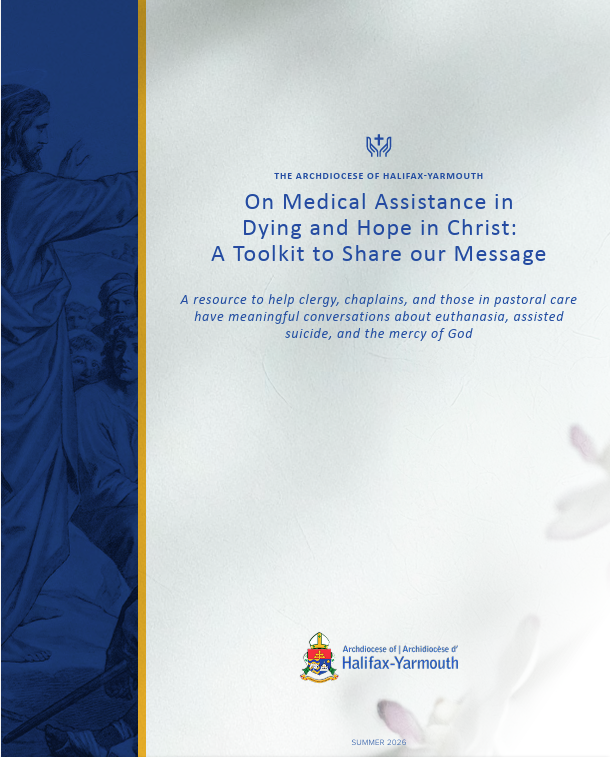 In June 2026, euthanasia, commonly known as MAiD, became legal in Canada. This changed the medical and healthcare landscape for all Canadians. For Canadian Catholics specifically, this raises moral questions that lead to difficult conversations or to their avoidance.
To bring greater awareness, understanding, and faithful action regarding MAiD, the Archdiocese created a toolkit titled "On Medical Assistance in Dying and Hope in Christ: A toolkit to share our message". The toolkit equips people to:
- Understand the current context of MAiD in Canada and Nova Scotia
- Talk about MAiD with family, friends, and parishioners
- Understand our Catholic teaching and stance against MAiD
- Access further resources
The toolkit is aimed at clergy, hospital chaplains, and those in pastoral care; however, it is available to all. The toolkit is meant to be used as a DIGITAL RESOURCE on your computer, tablet, or phone, and can be accessed by clicking the toolkit image to the left.
Many of the links within the toolkit connect to the resource directly, apart from the links below:
Dying with Christ, Living with Hope
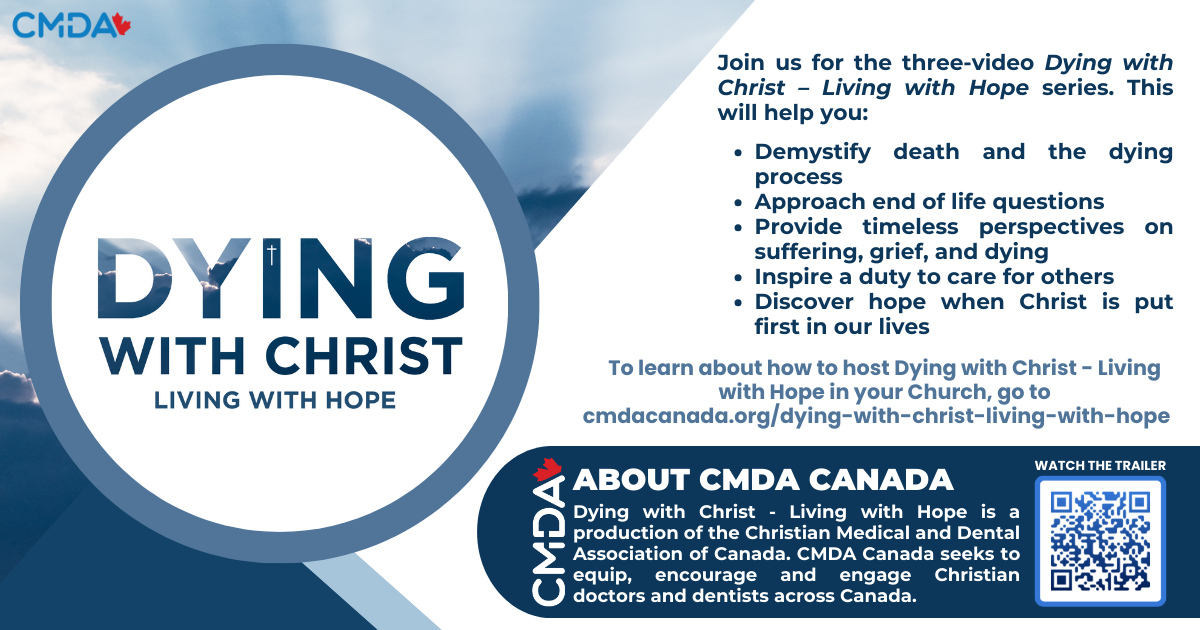

Dying with Christ – Living with Hope is a faith-filled program that speaks to one of the most important topics of our human experiences. Led by theologians and Christian healthcare professionals, this series offers meaningful insight into suffering, grief, dying, the duty to care, and how we can enter more deeply into the Christian hope of dying with Christ.
Dying with Christ – Living with Hope is a faith-filled program that speaks to one of the most important topics of our human experiences. Led by theologians and Christian healthcare professionals, this series offers meaningful insight into suffering, grief, dying, the duty to care, and how we can enter more deeply into the Christian hope of dying with Christ.
Dying with Christ – Living with Hope is a faith-filled program that speaks to one of the most important topics of our human experiences. Led by theologians and Christian healthcare professionals, this series offers meaningful insight into suffering, grief, dying, the duty to care, and how we can enter more deeply into the Christian hope of dying with Christ.

Dying with Christ – Living with Hope is a faith-filled program that speaks to one of the most important topics of our human experiences. Led by theologians and Christian healthcare professionals, this series offers meaningful insight into suffering, grief, dying, the duty to care, and how we can enter more deeply into the Christian hope of dying with Christ.
The Christian Medical and Dental Association of Canada (CMDA) is offering two live online opportunities to participate in this three-session series. Participants will not only experience the program firsthand but will also be equipped to bring it to their own communities, parishes, and ministry settings. A chance to bring Christ’s message of hope to our world.
Summer 2026 Online Series Options:
- Mondays, August 10, 17, and 24 at 1:00 PM AT
- Thursdays, September 10, 17, and 24 at 8:00 PM AT
To register visit: https://cmdacanada.org/event/dying-with-christ-living-with-hope-summer-series/
Questions? Contact Brad MacKinnon via email:
For more information on CMDA visit: cmdacanada.org
Pastoral Letters on Physician Assisted Dying
* Pastoral Letter on Physician Assisted Dying (Eng/Fr)
By Archbishop Mancini - Link
(includes a download - FAQ on Physican Assisted Dying)
* A Pastoral Reflection on Medical Assistance in Dying
by the Atlantic Bishops
English
French