


On Medical Assistance in Dying and Hope in Christ: A toolkit to share our message
 In June 2026, euthanasia, commonly known as MAiD, became legal in Canada. This changed the medical and healthcare landscape for all Canadians. For Canadian Catholics specifically, this raises moral questions that lead to difficult conversations or to their avoidance.
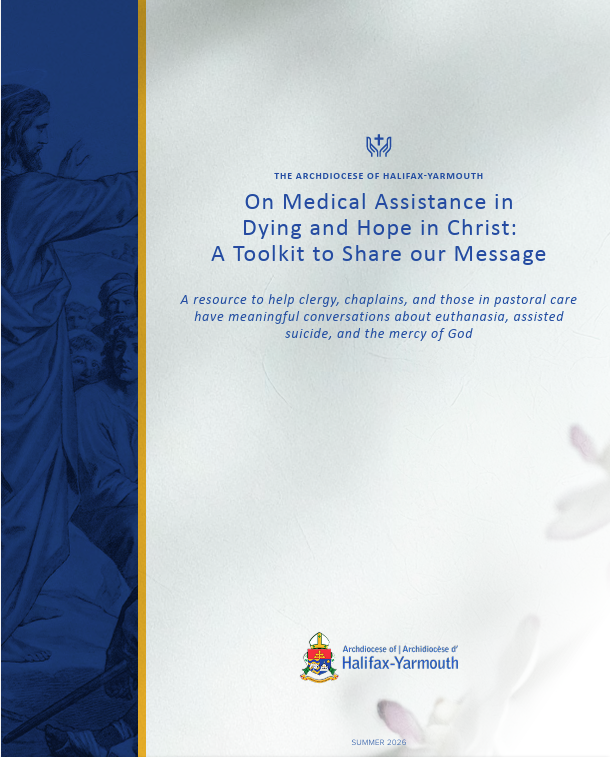
To bring greater awareness, understanding, and faithful action regarding MAiD, the Archdiocese created a toolkit titled "On Medical Assistance in Dying and Hope in Christ: A toolkit to share our message". The toolkit equips people to:
- Understand the current context of MAiD in Canada and Nova Scotia
- Talk about MAiD with family, friends, and parishioners
- Understand our Catholic teaching and stance against MAiD
- Access further resources
The toolkit is aimed at clergy, hospital chaplains, and those in pastoral care; however, it is available to all. The toolkit is meant to be used as a DIGITAL RESOURCE on your computer, tablet, or phone, and can be accessed by clicking the toolkit image to the left.
Many of the links within the toolkit connect to the resource directly, apart from the links below:
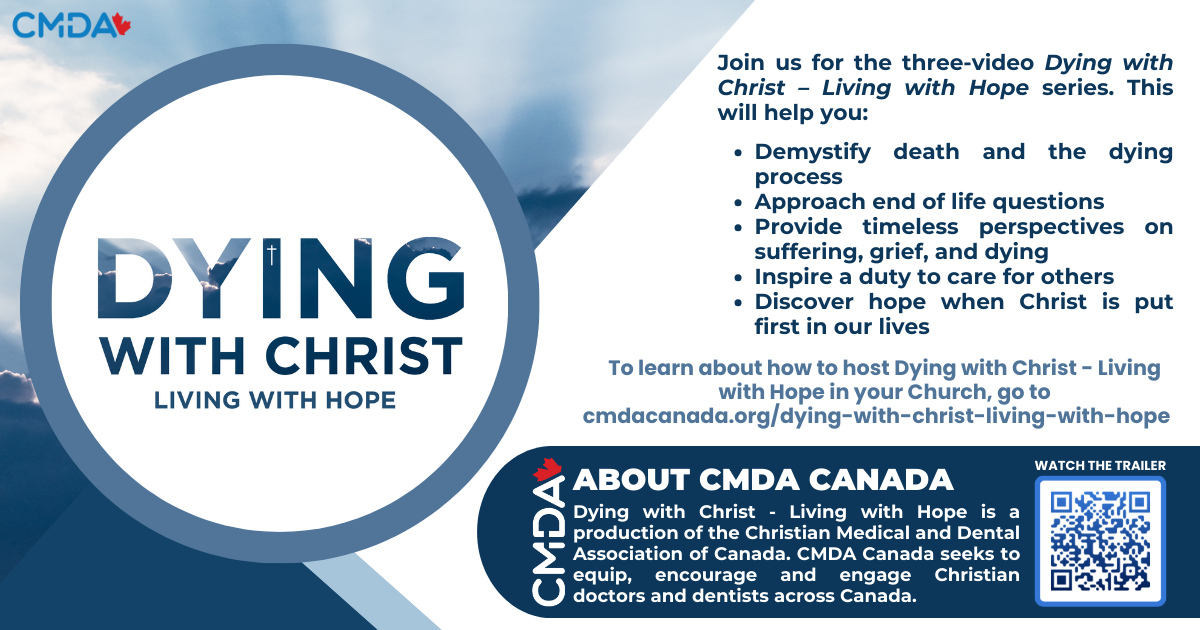
Dying with Christ, Living with Hope

Imagine a healthcare system where death is considered a therapeutic treatment. Imagine being a Christian doctor in that system. Imagine being told by your medical regulator that you are abandoning your patient if you don’t make arrangements for them to get an assessment for euthanasia. That healthcare system is in Nova Scotia today. The Nova Scotia medical regulator is pushing through a policy that would force physicians to refer patients for euthanasia, abortion, and transgender services. Twenty-three courageous Christian physicians have told Nova Scotia’s medical regulator that they cannot abide by this new draft policy.

This program is a three-part series that presents a hope-filled perspective on a universal experience using video presentations, a workbook, and small group discussions. The video presentations, featuring theologians and healthcare professionals, give timeless perspectives on suffering, grief, dying, our duty to care, and how dying with Christ is attainable for everyone.

Late last week the Canadian Bishops released a statement regarding the non-permissibility of MAiD in health organization with a Catholic identity. In part the statement reads:

There is ever-growing concern for how euthanasia, or medical assistance in dying (MAiD), is evolving across Canada. As Catholics how do we respond? Archbishop Dunn encourages the faithful to educate themselves on the issue and our Catholic teaching on the dignity of life. Last week Archbishop Dunn released a letter to the faithful that expressed his concern about MAiD and offers some resources. You can read the full letter here or pdf.

