On Medical Assistance in Dying and Hope in Christ: A toolkit to share our message
In June 2026, euthanasia, commonly known as MAiD, became legal in Canada. This changed the medical and healthcare landscape for all Canadians. For Canadian Catholics specifically, this raises moral questions that lead to difficult conversations or to their avoidance.
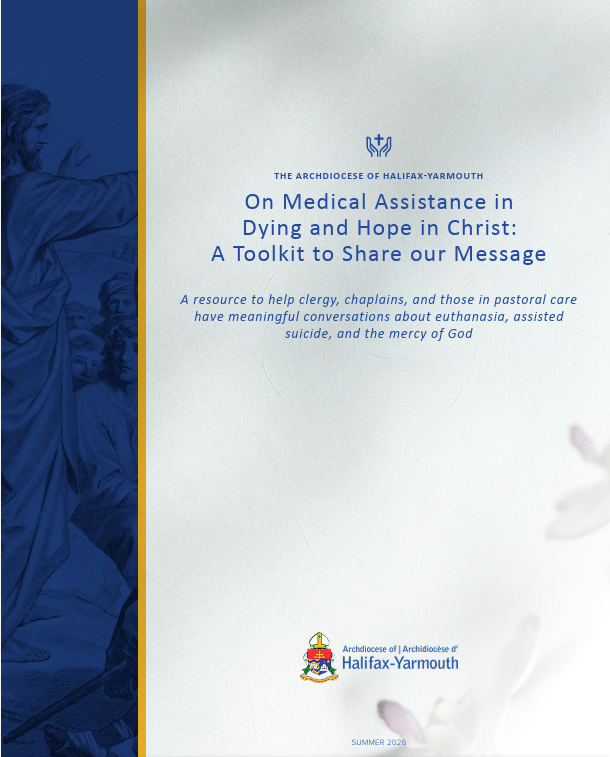
To bring greater awareness, understanding, and faithful action regarding MAiD, the Archdiocese created a toolkit titled "On Medical Assistance in Dying and Hope in Christ: A toolkit to share our message". The toolkit equips people to:
- Understand the current context of MAiD in Canada and Nova Scotia
- Talk about MAiD with family, friends, and parishioners
- Understand our Catholic teaching and stance against MAiD
- Access further resources
The toolkit is aimed at clergy, hospital chaplains, and those in pastoral care; however, it is available to all. The toolkit is meant to be used as a DIGITAL RESOURCE on your computer, tablet, or phone, and can be accessed by clicking the toolkit image to the left.
Many of the links within the toolkit connect to the resource directly, apart from the links below:
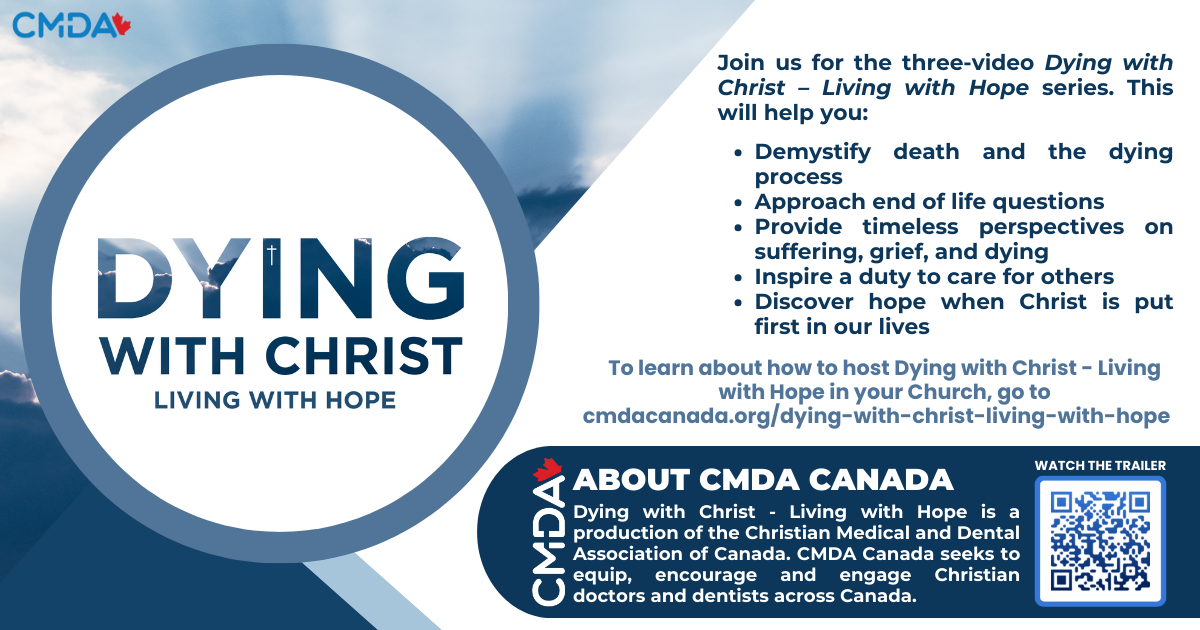
Dying with Christ, Living with Hope
Recently the Canadian Bishops, through the Canadian Conference of Catholic Bishops (CCCB) released information about the upcoming Bill C-41. This bill relates to the accessibility of MAiD to those whose sole underlying medical condition is mental illness as well as parameters around advance requests for MAiD. The Bishops sent a message to our government to split Bill C-41 since these are two very different issues. The concerns around advanced requests have not been debated and discerned as have the parameters around mental illness that are stated in this bill. In a media release shared on November 12, the CCCB invited Catholic Canadians to take a stand:
“The Permanent Council of the Canadian Conference of Catholic Bishops (CCCB) today sent a brief to parliamentarians urging them to split Bill C-41, the Medical Assistance in Dying Safeguards Act. The CCCB asks Parliament to maintain the exclusion from euthanasia and assisted suicide where mental illness is the sole underlying medical condition, and to remove the advance-request provisions. “Parliament has a responsibility to examine these questions before considering a change with irreversible consequences for people who can no longer give informed consent,” the brief states.
Advance requests would allow euthanasia after a person has lost decision-making capacity, potentially years after signing a request. The brief raises questions about how others would interpret the request and the person’s present responses, whether earlier fears correspond to their later experience, and how inadequate care, isolation, or pressure might influence decisions.”
The Canadian Bishops are urging all Canadians, Catholic or not, to take action without delay by taking part in their letter writing campaign which can be found at this link: Participate in the CCCB’s letter-writing campaign. It is expected that a vote and second reading of Bill C-41 is expected shortly.
The CCCB has also created a fact sheet: Advanced Requests for Euthanasia: What Catholics Need to Know about Bill C-41. Click the title to access the information or visit www.cccb.ca
