On Medical Assistance in Dying and Hope in Christ: A toolkit to share our message
 In June 2026, euthanasia, commonly known as MAiD, became legal in Canada. This changed the medical and healthcare landscape for all Canadians. For Canadian Catholics specifically, this raises moral questions that lead to difficult conversations or to their avoidance.
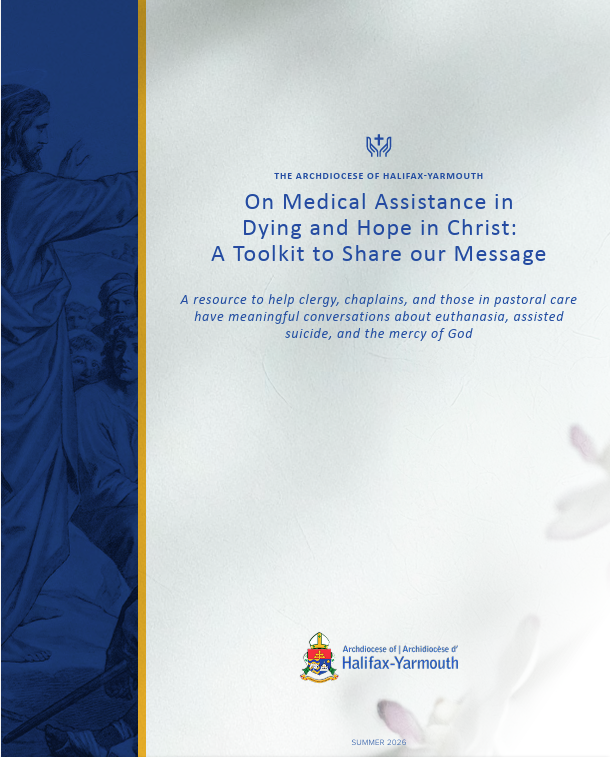
To bring greater awareness, understanding, and faithful action regarding MAiD, the Archdiocese created a toolkit titled "On Medical Assistance in Dying and Hope in Christ: A toolkit to share our message". The toolkit equips people to:
- Understand the current context of MAiD in Canada and Nova Scotia
- Talk about MAiD with family, friends, and parishioners
- Understand our Catholic teaching and stance against MAiD
- Access further resources
The toolkit is aimed at clergy, hospital chaplains, and those in pastoral care; however, it is available to all. The toolkit is meant to be used as a DIGITAL RESOURCE on your computer, tablet, or phone, and can be accessed by clicking the toolkit image to the left.
Many of the links within the toolkit connect to the resource directly, apart from the links below:
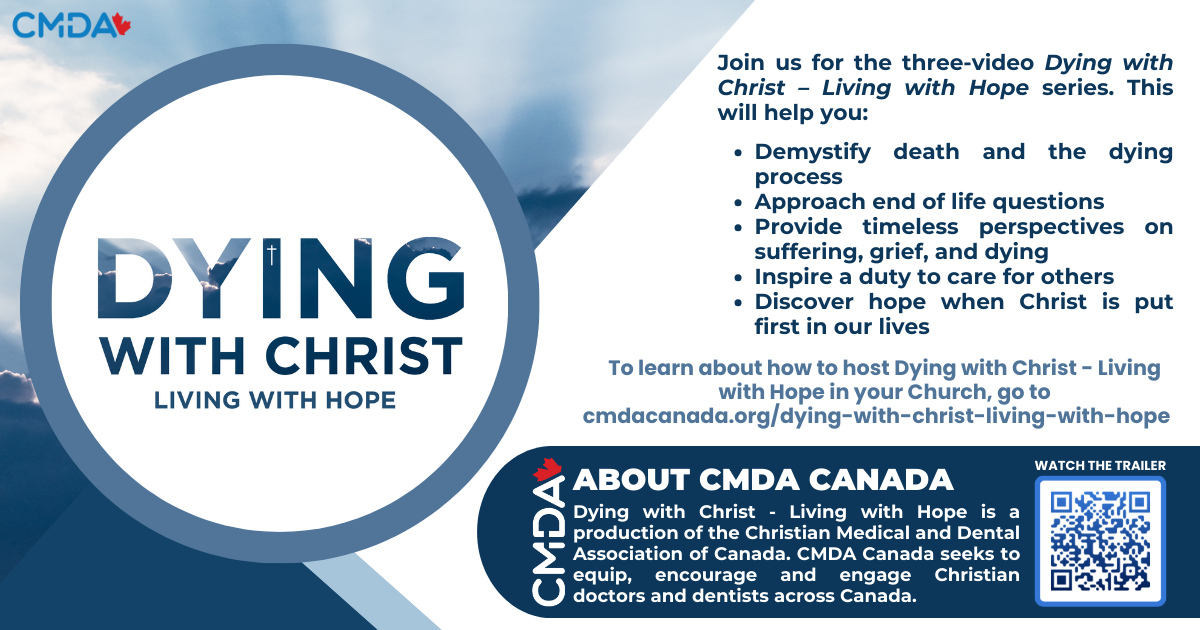
Dying with Christ, Living with Hope